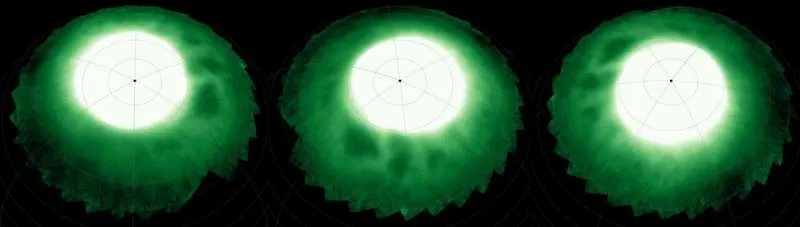
The James Webb Space Telescope (JWST) has uncovered remarkable and previously unseen features in Saturn's atmosphere, offering new insights into the planet's complex weather systems. Utilizing its advanced infrared capabilities, JWST detected intricate patterns of dark, bead-like structures and an asymmetric star-shaped formation in the upper layers of Saturn's atmosphere. These findings challenge existing models and open avenues for deeper understanding of atmospheric dynamics on gas giants.
Introduction
Saturn, the majestic ringed giant of our solar system, has long been a subject of fascination for astronomers and planetary scientists. While much has been learned about its composition and ring system, the intricacies of its atmospheric behavior remain elusive. Recent observations by NASA's James Webb Space Telescope (JWST) have provided unprecedented views into Saturn's atmosphere, revealing complex and previously unobserved features.
JWST's Observational Capabilities
Launched in 2021, the JWST is equipped with state-of-the-art instruments designed to observe the universe in infrared wavelengths. This capability allows scientists to peer through cosmic dust and gas clouds, providing clearer images of distant celestial bodies. Specifically, the Near-Infrared Spectrograph (NIRSpec) on JWST enabled detailed observations of Saturn's atmospheric layers, capturing data on molecular hydrogen ions (H₃⁺) and methane distributions.
Discovery of Dark Beads in the Ionosphere
One of the most striking findings from JWST's observations is the detection of dark, bead-like structures embedded within Saturn's auroral regions. These features, observed in the ionosphere approximately 1,100 kilometers above the planet's nominal surface, appear as dark spots amidst the bright auroral emissions. The precise nature and formation mechanisms of these "dark beads" remain a subject of ongoing research, but their unexpected presence challenges existing atmospheric models.
Asymmetric Star Pattern in the Stratosphere
Further investigations revealed an unusual star-shaped pattern in Saturn's stratosphere, about 600 kilometers above the surface. This structure extends from the planet's north pole towards the equator, but intriguingly, only four of its six arms are visible, creating a lopsided appearance. The alignment of this star pattern with Saturn's well-known hexagonal storm at the north pole suggests a possible connection between these atmospheric phenomena, though the exact relationship is yet to be understood.
Implications for Atmospheric Science
These discoveries have significant implications for our understanding of planetary atmospheres, particularly those of gas giants like Saturn. The presence of intricate and previously unobserved structures indicates that Saturn's atmosphere is more dynamic and complex than previously thought. These findings may necessitate revisions to current atmospheric models, incorporating new factors to account for the observed phenomena.
Conclusion
The James Webb Space Telescope's observations of Saturn's atmosphere have unveiled a new realm of complexity and intrigue. The detection of dark bead-like structures and an asymmetric star pattern challenges existing models and opens new avenues for research into the atmospheric dynamics of gas giants. As scientists continue to analyze the data, these findings promise to enhance our understanding of planetary atmospheres and the processes that govern them.
Comments