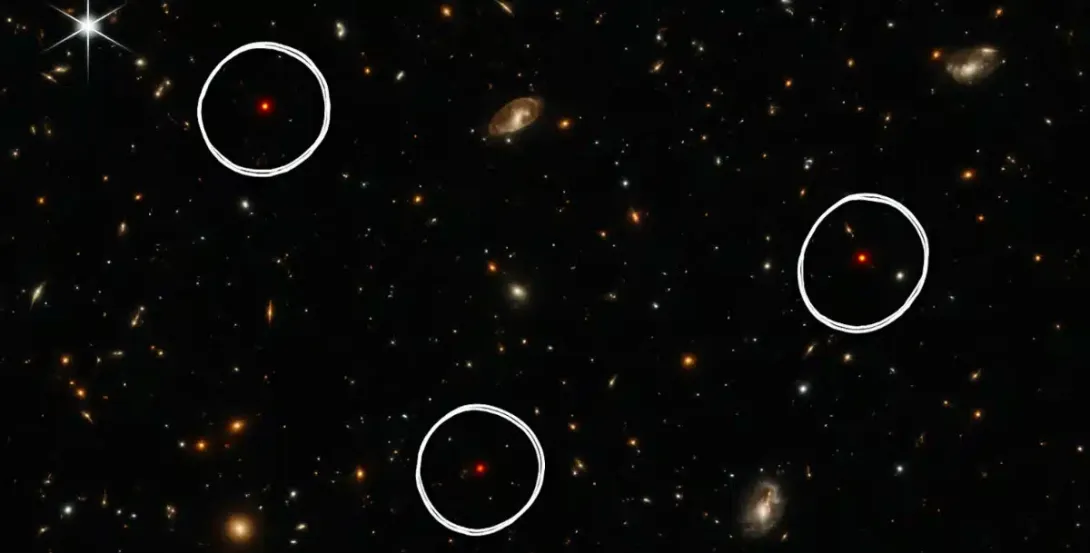
NASA’s James Webb Space Telescope (JWST) has captured a series of faint, distant galaxies nicknamed the “Little Red Dots,” providing an unprecedented glimpse into the early universe. These compact, red-shifted objects represent some of the earliest galaxy formations, billions of light-years away, offering critical insights into cosmic evolution shortly after the Big Bang. By analyzing their light signatures, astronomers are uncovering details about star formation, galaxy morphology, and chemical composition in the universe’s formative epochs. The discovery reinforces JWST’s transformative role in observational astronomy, enabling scientists to study previously inaccessible regions of space and refine models of galaxy formation and growth.
Discovery and Observation
The “Little Red Dots” were detected using JWST’s near-infrared instruments, which can penetrate cosmic dust and observe highly red-shifted light from the early universe. Their compact size and reddish hue indicate they are both distant and ancient, with light traveling billions of years before reaching Earth. These galaxies provide a direct snapshot of conditions within the first few hundred million years following the Big Bang.
Scientific Significance
Observing these early galaxies helps scientists understand the processes behind initial star formation, galactic assembly, and chemical enrichment. Analysis of their spectra reveals the presence of hydrogen, helium, and traces of heavier elements, offering clues to the lifecycle of the first stars. These findings challenge and refine existing models of early galaxy formation and evolution, providing empirical data to anchor cosmological theories.
Technological Breakthroughs
JWST’s advanced infrared capabilities are central to this discovery. Unlike previous telescopes, Webb can observe faint, distant galaxies without interference from cosmic dust or atmospheric distortion. High-resolution imaging and spectroscopic analysis allow astronomers to map stellar populations, measure distances with unprecedented precision, and study galactic morphology in the early universe.
Broader Implications
The detection of the “Little Red Dots” demonstrates the transformative potential of next-generation space telescopes for understanding cosmic history. Beyond pure astronomy, these observations inform fundamental physics, including dark matter distribution, galaxy clustering, and cosmic expansion. They also provide a roadmap for future missions targeting the universe’s earliest epochs.
Conclusion
JWST’s capture of the “Little Red Dots” represents a landmark in observational astronomy, opening a window into the universe’s formative years. By studying these primordial galaxies, scientists gain insights into star formation, chemical evolution, and galactic growth, advancing our understanding of cosmic history. This discovery underscores the telescope’s pivotal role in shaping 21st-century astronomy, offering a transformative perspective on the cosmos billions of years ago.
Comments