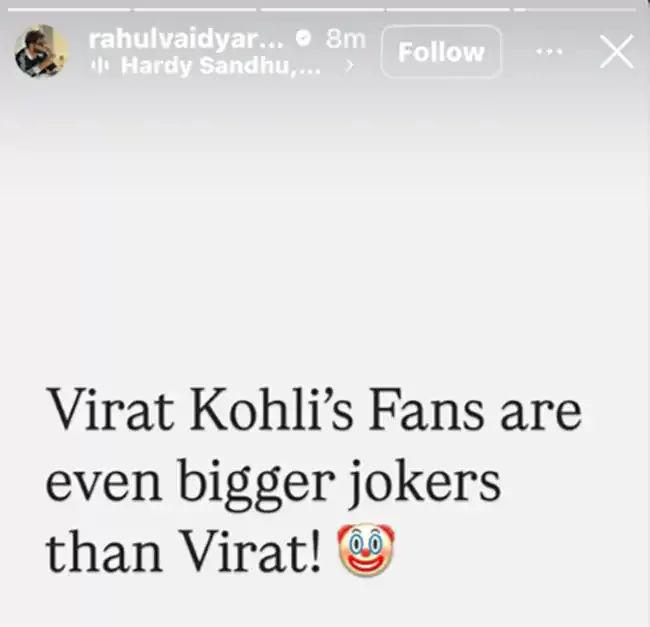
In a bizarre collision of social media dynamics, celebrity ego, and fan fervor, Indian singer Rahul Vaidya stirred controversy by calling cricket superstar Virat Kohli a “joker,” igniting a digital firestorm. The uproar began after Kohli inadvertently “liked” a post featuring actress Avneet Kaur, an action he later attributed to Instagram’s algorithm. Vaidya publicly mocked this explanation, triggering backlash from Kohli’s loyal fanbase. As the situation escalated, Kohli reportedly blocked Vaidya on Instagram—though the singer sarcastically blamed the platform’s algorithm again. This episode highlights the unpredictable influence of social media algorithms on personal reputations and public perception.
The Incident: A Like That Sparked a Firestorm
What began as a seemingly innocent “like” on a post by Bollywood actress Avneet Kaur quickly turned into headline material when it came from Virat Kohli’s verified Instagram account. The post in question attracted immense attention—not because of its content, but because of who interacted with it. Fans and media outlets speculated on the implications, prompting Kohli to issue a public clarification: it was all a technical error, a consequence of Instagram’s algorithm, not an intentional engagement.
Kohli’s explanation was meant to defuse the situation, but instead it opened the floodgates for satire—most notably from singer and reality TV personality Rahul Vaidya, who seized the opportunity to offer a tongue-in-cheek critique.
Rahul Vaidya Responds: Sarcasm or Strategy?
In a series of posts and stories, Rahul Vaidya mocked Kohli’s explanation. “I didn’t call him crazy, I called him a joker,” he quipped in a media interaction, a statement that inflamed Kohli’s passionate fanbase. Vaidya further ridiculed the idea of algorithmic engagement by mimicking Kohli’s clarification in a parody video:
“Going forward, the algorithm might like many photos I didn’t like. So, ladies, please don’t do PR about it—it’s not my fault, it’s Instagram’s.”
The singer's persistent jabs blurred the lines between satire and trolling, shifting the narrative from a glitch to a potential celebrity feud—a move that could be seen as either opportunistic attention-seeking or a bold commentary on social media absurdities.
Digital Fallout: Blocks, Glitches, and Backlash
The saga took another turn when Vaidya claimed that Kohli had blocked him on Instagram. Rather than retreat, the singer once again leaned into sarcasm:
“I think that too is an Instagram glitch. Maybe the algorithm blocked me on Kohli’s behalf.”
This kind of rhetoric, while entertaining to some, raised questions about celebrity accountability, algorithmic influence, and the increasingly blurred boundary between public image and private behavior. Kohli, known for maintaining a carefully curated public persona, did not respond further—a likely attempt to prevent the issue from escalating further.
Fan Reactions: Loyalty Meets Outrage
Kohli’s fanbase, one of the most dedicated and vocal in Indian sports, didn’t take kindly to Vaidya’s comments. Social media platforms became battlegrounds of hashtags, memes, and digital vitriol. The singer’s “joker” comment, in particular, was widely condemned. For many fans, it wasn’t just a jab at Kohli—it was a slight against the cricketer's integrity and the image he represents.
The backlash serves as a reminder of the emotional investment that fans place in public figures and the volatile nature of digital influence. What might have once been a trivial online spat now becomes a test of reputational resilience.
Broader Implications: Social Media and the Reputation Economy
Beyond the headline drama, this incident underscores a deeper issue: how algorithms, automation, and impulsive commentary intersect to shape public discourse. When celebrities claim that unintended likes or follows are due to "glitches," they shift accountability from themselves to opaque tech systems. While plausible, this reasoning also invites skepticism—and ridicule.
For influencers and public figures navigating today’s reputation economy, such moments are high-stakes. The price of a misstep isn’t just embarrassment—it can mean lost endorsements, media scrutiny, and damaged trust.
Conclusion: A Cultural Snapshot in the Digital Age
The Kohli-Vaidya saga is more than celebrity drama—it’s a cultural case study on how digital platforms amplify minor events into major spectacles. It reflects a broader trend where algorithms, human error, and online performance converge in unpredictable ways. As India’s digital economy continues to grow, incidents like this will likely become more frequent—and more consequential.
The question now isn’t whether Instagram’s algorithm glitched. It’s how much longer public figures can afford to blame it.
Comments