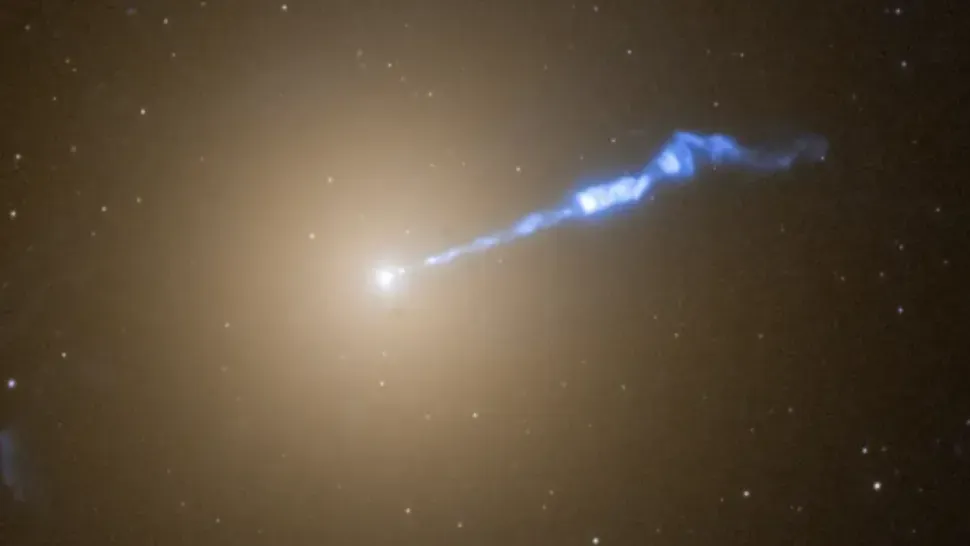
Astronomers studying the giant elliptical galaxy Messier 87, or M87, have reported fresh insights that further refine understanding of extreme cosmic environments. Best known for hosting the first black hole ever directly imaged, M87 continues to serve as a natural laboratory for testing theories of gravity, high-energy physics and galaxy evolution. Recent observations, combining data from space- and ground-based telescopes, have shed new light on the galaxy’s relativistic jet, stellar dynamics and the behavior of matter near its supermassive black hole. The findings reinforce M87’s central role in modern astrophysics and long-term observational science.
Why M87 Remains a Focus of Global Research
Located roughly 55 million light-years from Earth, M87 is one of the most massive galaxies in the nearby universe. At its core lies a supermassive black hole billions of times more massive than the Sun, making it an ideal subject for studying extreme gravitational environments.
Astronomers value M87 not only for its size but also for its proximity, which allows detailed, high-resolution observation unavailable for more distant galaxies.
Advances in Black Hole Observation
Building on the landmark Event Horizon Telescope image, researchers continue to analyze M87’s black hole using improved observational techniques. New data have helped refine estimates of the black hole’s mass, spin and the structure of the surrounding accretion disk.
These measurements provide critical tests for Einstein’s theory of general relativity under conditions that cannot be replicated in laboratories on Earth.
Insights Into the Powerful Jet
One of M87’s most striking features is its immense jet of high-energy particles, extending thousands of light-years into intergalactic space. Recent studies have focused on how this jet is launched and sustained.
Astronomers now have stronger evidence that magnetic fields near the black hole play a dominant role in accelerating particles to near-light speed, offering a clearer picture of how energy is transported across vast cosmic distances.
Implications for Galaxy Evolution
Understanding M87 has broader implications beyond black hole physics. The interaction between its central black hole and surrounding gas appears to regulate star formation across the galaxy.
This feedback mechanism is increasingly seen as a key factor in explaining why massive galaxies like M87 evolve differently from smaller systems, shaping long-term cosmic structure.
Strategic Value of Long-Term Observation
From a research and funding perspective, M87 illustrates the return on sustained investment in astronomical infrastructure. Observations rely on coordinated use of radio arrays, optical telescopes and space-based observatories.
Such multi-platform collaboration maximizes scientific output while spreading costs across institutions and nations, making frontier science economically sustainable.
Conclusion
M87 continues to stand at the crossroads of observational astronomy and theoretical physics. Each new study adds incremental clarity to some of the universe’s most complex processes, from black hole dynamics to galaxy-scale evolution. As technology advances, astronomers expect M87 to remain a cornerstone of astrophysical research, offering insights that extend far beyond a single galaxy and deepen understanding of the cosmos itself.
Comments